What Defines a Standard Binola Jute Bag?
The term “Binola” originates from the historical commercial trade word for cottonseed. Originally engineered as the heavy-duty, breathable container for cotton ginning hubs, the Standard Binola Jute Bags construction has grown into the international commodity standard for packaging oilseeds, sesame, raw peanuts, dry legumes, and coarse grains.
Unlike lighter single-warp Hessian burlap wraps, Binola sacks are woven with heavy double-warp yarns (twill weave). This structural twill matrix yields outstanding bursting strength during mechanical conveyor transport, manual handling, and multi-tier warehouse stacking. As verified in our national trade profile on the Export Promotion Bureau (EPB) Exporter Registry, SA Shamim Jute Mills Ltd weaves these sacking bags in compliance with Bangladesh Standards (BDS) and international agricultural export norms.
Technical Specifications of Standard Binola Jute Bags
To ensure flawless customs clearance and satisfy pre-shipment inspections at destination ports such as Port Sudan, Mombasa, and Alexandria, each production lot of Standard Binola Jute Bags follows rigorous mill benchmarks:
| Metric | Export Mill Benchmark (SA Shamim Standard) |
|---|---|
| Cut Size | 44″ × 26.5″ (112 cm × 67.3 cm) |
| Tare Weight | 2.00 lbs nominal 907 grams (± 3% tolerance) |
| Weave | 6 Porter × 7 Shots Twill weave |
| Stripes | 3 Blue Stripes running lengthwise along center |
| Mouth | Hemmed cleanly at mouth to prevent unraveling |
| Sewing | Overhead dry sewn with 3-ply high-tensile jute twine |
| Moisture | 14% to 16% strictly maintained under oven tests |
| Baling | 300 bags per hydraulic compressed export bale |
Our integrated plant operates 352+ heavy industrial machines across a 6+ Acre campus in Bochaganj, Dinajpur. This heavy manufacturing footprint guarantees consistent yarn tension, uniform weight distribution, and high seam burst resistance across rolling monthly orders. To explore our broader line of carpet backing yarn and sacking constructions, visit our complete jute products catalog.
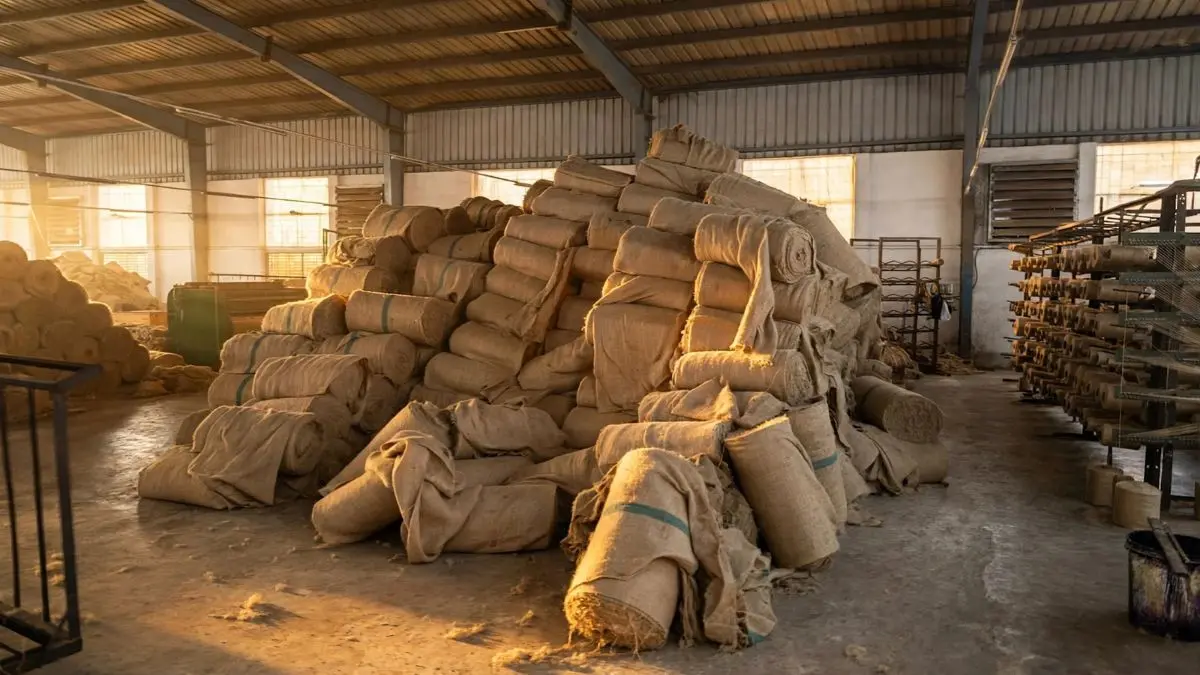
Standard Binola Jute Bags vs. B-Twill vs. Heavy Sugar Sacks
International commodity merchants frequently compare Standard Binola Jute Bags against standard B-Twill sacks and heavier A-Twill containers to optimize their packaging cost per metric ton:
| Bag Classification | Cut Dimensions | Nominal Weight | Weave Density | Primary Commodity Use |
|---|---|---|---|---|
| Standard Binola Bags | 44″ × 26.5″ | 2.00 lbs 907g | 6 × 7 | 50–75 kg Oilseeds, Sesame, Peanuts |
| Standard B-Twill Bags | 44″ × 26.5″ | 2.25 lbs 1,020g | 6 × 8 | 75–90 kg Wheat, Rice, Coarse Grain |
| Heavy A-Twill Bags | 44″ × 26.5″ | 2.62 lbs 1,190g | 8 × 9 | 90–100 kg Sugar, Grains, Heavy Beans |
| Standard Sugar Bags | 48″ × 28″ | 2.50–2.75 lbs 1,134–1,247g | 6 × 8 / 8 × 8 | 100 kg Refined Sugar & Fertilizer |
Container Stuffing Mathematics for Standard Binola Jute Bags (20ft vs 40ft FCL)
Maximizing container payload is the most direct method to reduce landed CIF freight costs per bag. Because each unit of Standard Binola Jute Bags weighs exactly 2.00 lbs (907g), container stuffing calculations remain highly uniform:
| Loading Parameter | 20-Foot Ocean Container (FCL) | 40-Foot High Cube Container (HC) |
|---|---|---|
| Total Export Bales | 70 Bales (Hydraulic pressed) | 85 to 90 Bales |
| Bags per Bale | 300 Bags per Bale | 300 Bags per Bale |
| Total Delivered Sacks | 21,000 Bags | 25,500 to 27,000 Bags |
| Net Commodity Cargo | 19.05 Metric Tons | 23.13 to 24.49 Metric Tons |
| Gross Shipping Weight | Approx. 19.8 MT (with hoops & wrap) | Approx. 25.5 MT (highway compliant) |
All export bales are compressed on heavy hydraulic baling presses, strapped securely with high-tensile steel bands, and wrapped in virgin protective Hessian fabric. Ocean dispatches move directly from our plant yard to Chattogram Sea Port (BDCGP), while overland cargo destined for India and regional borders clears via Benapole, Sona Masjid, and Bhomra land customs.
Quality Audit & Pre-Shipment Inspection Protocol
For high-value agricultural trade, international buyers routinely appoint independent surveyors such as SGS, Intertek, or Bureau Veritas. Our quality control desk verifies every consignment of Standard Binola Jute Bags against a strict 4-step protocol:
Bale Tare Verification: Selecting random sample bales to confirm that 300 bags match the 600 lbs net weight standard within contract tolerance.
Overhead Seam Strength: Performing tensile tear tests along the side seams and hemmed mouth to guarantee safety during high-speed mechanical hopper filling.
Hydrocarbon-Free Verification: For food-grade agricultural packaging, running dedicated batching lines compliant with IJIRA laboratory guidelines and German BfR Method 2009 for zero MOSH/MOAH contamination.
Moisture & Desiccant Check: Validating that moisture regain does not exceed 14% to 16% prior to container stuffing to prevent condensation and mold during sea transit.
Frequently Asked Questions: Standard Binola Jute Bags
What are the exact dimensions and weight of Standard Binola Jute Bags?
How many Binola jute bags fit into a 20ft ocean container?
Why do Standard Binola Jute Bags feature 3 blue stripes?
Can buyers obtain physical laboratory swatches before issuing an L/C?
Request Factory-Direct FOB or CIF Binola Quotations
Secure stable contract supply for Standard Binola Jute Bags backed by our 1,000+ MT monthly output. Contact Managing Director Shamim Akhter Hossain’s export operations desk for immediate pricing and shipping schedules.