6+ Acre Integrated Jute Manufacturing Mill & Processing Facility
Operating 352+ heavy industrial machines with an 1,100+ skilled workforce in Bochaganj, Dinajpur. Delivering 1,000+ MT monthly export capacity with MOSH/MOAH test report compliance (IJIRA Kolkata Ref: TSR-195/2026-27 under German BfR Method 2009).
Industrial Mill Campus
Batason, Muraripur, Bochaganj, Dinajpur. Purpose-built composite jute manufacturing infrastructure.
Heavy Industrial Machines
Softening lines, carding frames, drawing sets, high-speed flat looms & hydraulic baling presses.
Skilled Factory Workforce
Full technical operational shift compliance under DIFE Factory License: 27-21-1-056-00001.
Monthly Export Capacity
IJIRA Lab Test Report Ref TSR-195/2026-27 tested: MOSH & MOAH compliant food-grade sacking.
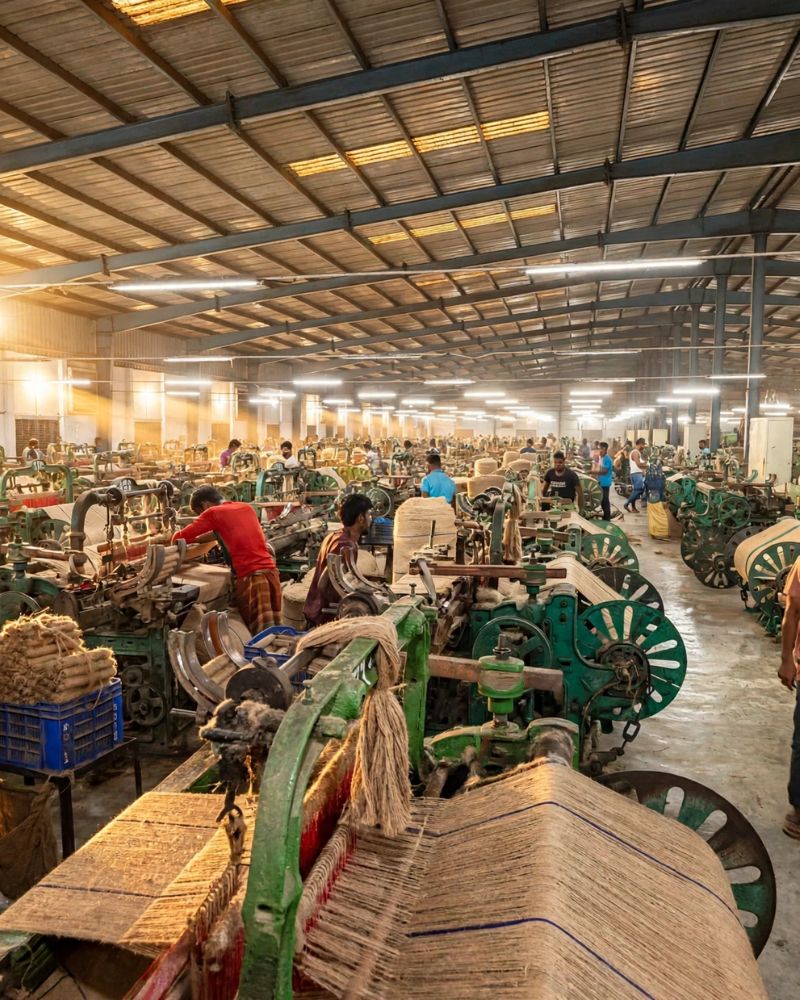
Integrated Jute Manufacturing & Baling Complex
Established in 2019, SA Shamim Jute Mills operates one of Northern Bangladesh's leading composite jute manufacturing facilities in Batason, Muraripur, Bochaganj, Dinajpur—housing 352+ heavy industrial machines delivering 1,000+ MT monthly export capacity.
Dedicated raw fiber sorting sheds, mechanical carding bays, multi-frame spinning sheds, automated weaving halls, and hydraulic baling presses.
Equipped with a captive power sub-station for 24/7 manufacturing operations and direct trailer freight access to Chattogram Port (BDCGP).
Fully compliant with Bangladesh Ministry of Labour safety standards under DIFE Factory License No. 27-21-1-056-00001 (valid through August 2027).
Officially registered exporter under Export Promotion Bureau EPB Exporter ID: 1968 and an active member of the Bangladesh Jute Mills Association (BJMA).
8-Stage Precision Jute Manufacturing & Export Processing
SA Shamim Jute Mills operates an integrated 8-stage manufacturing process across 352+ heavy industrial machines delivering 1,000+ MT monthly export capacity. Food-grade packaging adheres strictly to independent laboratory test standards verified by an IJIRA Kolkata Lab Test Report (Ref: TSR-195/2026-27 under German BfR Method 2009).
Selection & Vegetable Batching
Raw tossa and white jute fibers are sorted by grade, tensile strength, and color. Fibers undergo batch conditioning with 100% refined vegetable oil emulsions (VOT), ensuring MOSH and MOAH hydrocarbon migration levels remain strictly below the limit of detection (< LOD) under German BfR Method 2009.
Breaker & Finisher Carding
Batched jute reeds pass through high-speed breaker and finisher carding machines. Heavy pinned cylinders comb, split, and clean the fibers, stripping away unretted barks and root ends to form continuous, uniform slivers.
Multi-Stage Drawing & Doubling
Slivers are processed through 3 sequential drawing passages (first, second, and finisher drawing). The doubling and drafting process parallelizes fiber orientation, evens out linear mass variation, and eliminates cross-sectional thick-thin spots.
High-Speed Ring & Flyer Spinning
Drawn slivers are fed into modern spinning frames to impart precise twist per inch (TPI). Our spinning fleet produces yarn counts ranging from 8 lbs to 28 lbs in single, 2-ply, and multi-strand configurations with high tensile resistance.
Precision Winding & Spooling
Spun yarn is transferred via automatic cone and cheese winding machines. Tension-controlled spooling eliminates weak knots, surface slubs, and loose fibers, producing uniform spools ready for the weaving beam or direct export palletizing.
Heavy Loom Industrial Weaving
Yarn beams are mounted onto automatic cop-change and rapier weaving looms. We produce heavy twill sacking fabric (A-Twill, B-Twill) and open-mesh Hessian burlap cloth with strict warp/weft porter and shot counts.
Calendering, Cutting & Stitching
Woven fabric rolls undergo heavy-pressure roller calendering to flatten the weave and lock fibers. Automated mechanical cutters slice cloth to millimeter dimensions, followed by heavy-duty Herakles safety overhead and side-seam stitching.
Quality Audit & Hydraulic Baling
Finished bags and yarns undergo moisture metering (maintained strictly within the 14%–16% export standard). Units are packed into 200–500 bag bundles under heavy hydraulic baling presses with steel strap reinforcement for deep-sea FCL transit via Chattogram Port (BDCGP).
Engineered for Precision, Volume & Global Export Deadlines
Backed by our dedicated captive power substation and an 1,100+ skilled workforce in Dinajpur, SA Shamim Jute Mills guarantees uninterrupted manufacturing with direct multimodal container logistics to Chattogram Sea Port (BDCGP) and regional land borders.
IJIRA-Tested Laboratory Standards & Food-Grade Compliance
SA Shamim Jute Mills enforces multi-stage quality control to ensure that all export food packaging maintains mineral oil saturated hydrocarbons (MOSH) and aromatic hydrocarbons (MOAH) below the limit of detection (< LOD), fulfilling international food-contact regulations under German BfR Method 2009.
MOSH & MOAH Food Safety
Tested by the Indian Jute Industries' Research Association (IJIRA), Kolkata using SPE-GC-FID analytical methodology under German BfR Method 2009 (Official Lab Test Report Ref: TSR-195/2026-27). Formulated with 100% refined vegetable oil batching (VOT) to eliminate mineral hydrocarbon migration into cocoa, coffee, and food grains.
Tensile & Seam Load Resistance
Every production run undergoes lea breaking strength tests, warp/weft tear resistance, and Herakles safety-stitch seam pull testing. Sacking bags undergo standardized 2.5-meter drop impact tests to ensure zero seam rupture during rough port and vessel handling.
Moisture Control & Clean Baling
Calibrated electronic moisture meters ensure raw and finished jute moisture regain remains strictly within the 14.0% to 16.0% export tolerance, eliminating mold risk during deep-sea ocean voyages. Bales are hydraulically pressed and container-stuffed for direct dispatch from Chattogram Port (BDCGP).
| Quality Parameter | Export Target / Factory Limit | Standardized Test Method | Target Application |
|---|---|---|---|
| MOSH & MOAH Content | Below Limit of Detection (< LOD) | SPE-GC-FID (BfR Method 2009) / IJIRA TSR-195 | Cocoa, Coffee & Grain Sacks |
| Moisture Regain Rate | 14.0% to 16.0% (Oven Dry Regain) | Electronic Moisture Meter / ISO 1833 | All Export Grade Bales |
| Drop Impact Burst Resistance | Zero rupture on 2.5m drop test | Standard Drop Test with 50-90 kg load | Heavy Twill Sacking Bags |
| Seam Breaking Strength | Minimum 450 N – 550 N | ISO 13935-2 / Constant Rate of Extension | Double Overhead Herakles Seam |
| Fabric Mass / GSM Tolerance | ± 5.0% Export Tolerance | ASTM D3776 / Standard Conditioning | Hessian Burlap & Sacking Fabric |
Buyer-Nominated Third-Party Inspections Welcome
We provide full laboratory access, sampling rights, and pre-loading container verification for international inspection agencies:
352-Machine Heavy Production Fleet & Technical Specifications
SA Shamim Jute Mills operates an integrated fleet of 352+ heavy production machines across its 6+ acre industrial campus in Dinajpur, Bangladesh. The machinery inventory is calibrated for continuous high-speed spinning, heavy twill weaving, and non-mineral food-grade export batching.
| Manufacturing Section | Machinery & Technology | Active Units | Technical Tolerances / Specs | Export Process Role |
|---|---|---|---|---|
| Batching & Softening Fiber Preparation | Heavy Emulsion Softeners & Jute Spreaders | 28 Units | Vegetable oil emulsion metering (Hydrocarbon-free / MOSH-MOAH < LOD compliant) | Moisture conditioning & raw reed softening |
| Carding Fleet Fiber Combing | Breaker Cards & Half-Circular Finisher Cards | 44 Units | High-speed pinned cylinders, automated root-cutting mechanism | Unretted bark removal & sliver transformation |
| Drawing & Drafting Sliver Uniformity | Triple-Passage High-Speed Drawing Frames | 48 Units | Push-bar & spiral screw gills, CV < 3.5% mass consistency | Fiber parallelization & linear density leveling |
| Spinning Fleet Yarn & Twine | Heavy Flyer Spinning & Ring Twisting Frames | 122 Units | Counts: 8 lbs/spindle to 28 lbs/spindle; 1-ply to 4-ply twists | Tensile-tested export yarn & weaving weft |
| Winding & Spooling Pre-Weaving Prep | Automatic Cop Winders & High-Speed Cone Spoolers | 36 Units | Tension-controlled continuous electronic winding | Slub-free export spools & shuttle cops |
| Weaving Department Fabric Production | Heavy-Duty Cop-Change Looms & Rapier Looms | 56 Units | Width: 20" to 72" (Standard Sacking & Wide Hessian); Porter/Shots: 6x7, 6x8, 8x8, 8x9, 11x12 | A-Twill, B-Twill sacking & Hessian burlap cloth |
| Finishing & Stitching Bag Conversion | Heavy 3-Bowl Calenders & Herakles Stitchers | 14 Units | Mechanical roll pressing, double-chain heavy overhead seam | Cloth smoothing, precision cut & seam reinforcement |
| Baling & Dispatch Container Packing | High-Pressure 200-Ton Hydraulic Baling Presses | 4 Units | 200 to 500 bags/bale; high-tensile steel hoop binding | FCL container load density optimization |
| TOTAL ACTIVE PRODUCTION FLEET | 352 Units | Monthly Production Capacity: 1,000+ Metric Tons | ||
27-21-1-056-00001, Valid to August 2027). Food-contact migration tested under German BfR Method 2009 (IJIRA Lab Test Report Ref: TSR-195/2026-27).
Frequently Asked Technical & Export Questions
Direct verified answers regarding SA Shamim Jute Mills' manufacturing scale, food-grade compliance (HS Code 6305.10 / HS Code 5307), and export logistics.
What is the monthly production and export capacity of SA Shamim Jute Mills? +
SA Shamim Jute Mills operates a 6+ acre integrated industrial manufacturing campus in Batason, Muraripur, Bochaganj, Dinajpur, Bangladesh. Operating an active fleet of 352+ heavy production machines with an 1,100+ skilled workforce, our monthly finished capacity exceeds 1,000+ Metric Tons of export-grade jute sacking bags, Hessian burlap cloth, and industrial yarn. Our plant operates under DIFE Factory License 27-21-1-056-00001 (valid through August 2027) and is registered with the Export Promotion Bureau under EPB Exporter ID: 1968.
Are SA Shamim jute bags tested food-grade compliant for cocoa, coffee, and edible nuts packaging? +
Yes. Our food-grade sacking bags (HS Code 6305.10) are manufactured using 100% refined vegetable oil batching (VOT - Vegetable Oil Treated) and are tested under IJIRA Kolkata official Lab Test Report reference IJIRA/CBPD/Analytical/TSR-195/2026-27. Tested using SPE-GC-FID methodology in compliance with European BfR Method 2009, our bags ensure MOSH (Mineral Oil Saturated Hydrocarbons) and MOAH (Mineral Oil Aromatic Hydrocarbons) levels remain strictly below the limit of detection (< LOD). Learn more on our Compliance & Testing Portal.
What are the container load limits (FCL) and bale packing standards for global shipment? +
We utilize high-pressure 200-ton hydraulic baling presses with high-tensile steel-hoop binding:
• 20-Foot Dry Container (20' FCL): Accommodates approximately 21.0 to 22.0 Metric Tons (200 to 500 bags per compressed export bale).
• 40-Foot High-Cube Container (40' HC): Accommodates approximately 26.0 to 27.0 Metric Tons (ideal for export jute yarn spools - HS Code 5307 and Hessian cloth rolls).
Which sea ports, land borders, and Incoterms are supported for export orders? +
Our primary ocean export gateway is Chattogram Sea Port (UN/LOCODE: BDCGP) for global dispatches under FOB, CFR, and CIF Incoterms 2020. For regional land export to India, Nepal, and Bhutan, we route bonded freight through Benapole, Sona Masjid, Bhomra, and Banglabandha land customs stations. Accepted payment methods include 100% Irrevocable L/C at Sight, Advance T/T, and CAD.
Multimodal Logistics, Container Loading & Trade Capabilities
Connecting our 6+ acre integrated manufacturing campus in Dinajpur directly to global deep-sea corridors and regional land ports. Complete FCL container stuffing, fumigation compliance, and flexible international trade execution.
Export Ports & Routing
Direct bonded freight corridors connecting our Dinajpur mill campus to key regional and international transit terminals:
-
▸
Primary Ocean Seaport: Chattogram Port (BDCGP) for FOB, CFR & CIF global vessel dispatches.
-
▸
Regional Land Borders: Benapole, Sona Masjid, Bhomra, and Banglabandha land customs stations.
-
▸
Statutory Customs Clearance: In-house documentation under EPB Exporter ID: 1968 and active BJMA authorization.
Container Packing Standards
High-density hydraulic bale compression engineered to maximize marine container volume and lower buyer freight-per-ton costs:
Trade Terms & Payment
Standardized commercial frameworks compliant with Incoterms 2020 for verified overseas buyers:
-
▸
Trade Terms: FOB Chattogram Port (BDCGP), CFR, or CIF Destination Port.
-
▸
Payment Security: 100% Irrevocable Letter of Credit (L/C) at Sight, Advance T/T, CAD.
-
▸
Quality Samples: Evaluation swatches, yarn spools, and sample sacking dispatched rapidly via DHL/FedEx.
Ready to Procure Direct from the Dinajpur Mill?
Receive formal factory-direct price quotations, schedule an on-site mill inspection, or request official IJIRA food-grade lab test reports (Ref: TSR-195/2026-27).