B Twill Jute Bags serve as the international standard for industrial packaging, storage, and cross-border maritime shipping of dry agricultural commodities. Across international grain supply chains in East Africa, the Middle East, and Southeast Asia, bulk commodity handlers routinely face cargo shrinkage, seam rupture during crane slings, and vessel moisture damage when using non-standard sacking. Procuring directly from a fully integrated primary manufacturer eliminates intermediary broker variance, ensuring that heavy-duty sacking meets rigid government tender requirements and ISO shipping tolerances.
Operating an integrated manufacturing campus located at Batason, Muraripur, Post: Setabganj, Bochaganj, Dinajpur, Bangladesh, SA Shamim Jute Mills Ltd operates 352+ heavy industrial spinning, winding, and weaving machines supported by a dedicated workforce of 1,100+ skilled personnel. Under the executive leadership of Founder and Managing Director Shamim Akhter Hossain, the mill maintains a monthly export capacity exceeding 1,000 metric tons of export-grade jute goods, registered under the Export Promotion Bureau (EPB Exporter ID: 1968) and holding active membership in the Bangladesh Jute Mills Association (BJMA).
Technical Specifications of B Twill Jute Bags for Bulk Export
Standard B. Twill sacking fabric is woven on heavy-duty industrial looms utilizing 100% natural Tossa raw jute (Corchorus olitorius), sorted from northern Bangladesh belts recognized for long staple length and high tensile endurance. The fabric is structured with a Double Warp (DW) 2/1 twill construction, designed to handle nominal payload weights ranging from 50 kg to 100 kg of rice, wheat, corn, green coffee, or refined cane sugar.
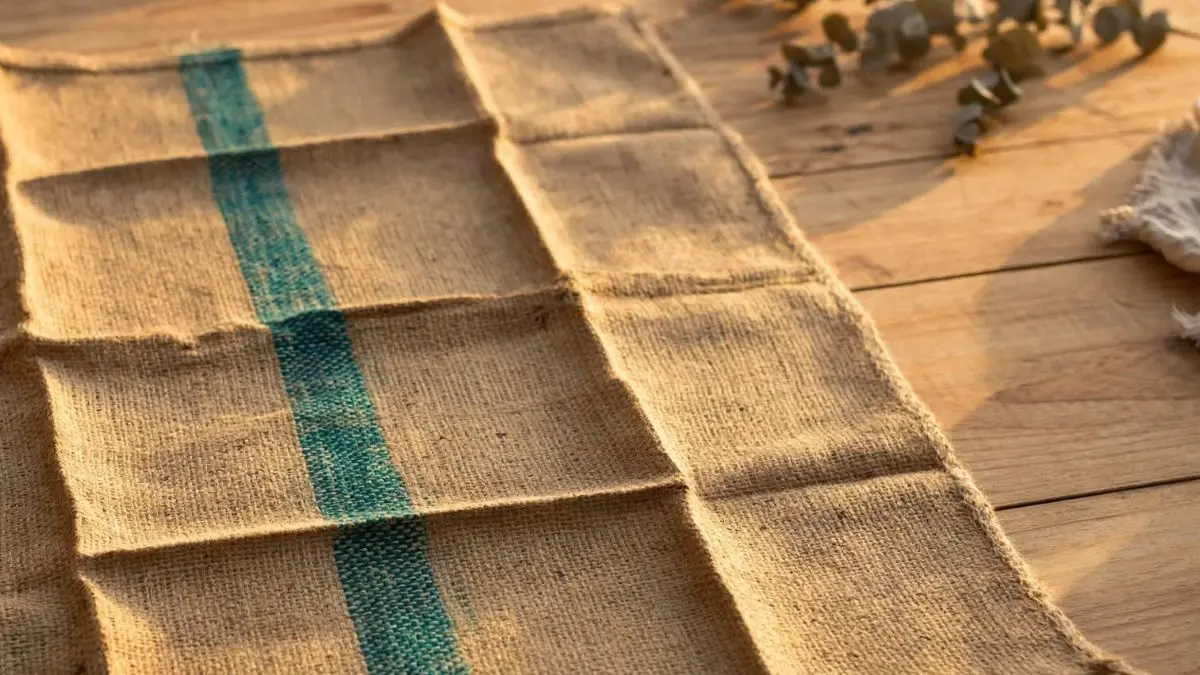
The standard export configuration features three distinctive woven blue stripes centered along the sack length. The bag mouth is clean cut and hemmed to prevent warp unraveling during high-speed mechanical hopper discharge. Side seams are closed using heavy overhead chain stitches (Herakles type) with high-ply natural jute twine, ensuring that pressure surges during port hoist netting do not lead to lateral seam slippage. Review full product portfolios at our jute products catalogue.
| Specification Parameter | Standard Heavy B. Twill | Light Sacking Twill | Testing Reference |
|---|---|---|---|
| Bag Dimensions (L × W) | 44″ × 26.5″ 112 cm × 67.3 cm | 38″ × 26.5″ 96.5 cm × 67.3 cm | BS EN ISO 22198 |
| Finished Unit Weight | 2.25 lbs 1,020 grams (±6%) | 2.00 lbs 907 grams (±6%) | ASTM D3776 / BIS |
| Weave Density (Porter × Shots) | 6 × 8 DW Twill Construction | 6 × 7 DW Twill Construction | ISO 7211-2 |
| Moisture Regain Limit | 14.0% – 16.0% Dry Base Control | 14.0% – 16.0% Dry Base Control | Oven Dry Method / ISO 6741 |
| Selvedge & Seam Closure | Herakles Safety Lockstitch | Overhead Dry Chain Stitch | ASTM D1683 Seam Strength |
| Identification Stripes | 3 Woven Blue Stripes | 2 or 3 Woven Blue Stripes | Commercial Tender Standard |
Seam Failure & Drop-Test Engineering in Port Handling
Bulk grain imports via discharge ports in Mombasa, Port Sudan, Djibouti, and Chittagong experience harsh physical impacts during crane grab unloading and stevedore handcart movements. Sacks manufactured from sub-grade cuttings or yarn counts below 28 lbs/spyndle tend to split at the bottom corner junctions. SA Shamim Jute Mills eliminates handling rupture by maintaining rigorous yarn twist parameters and applying heavy lockstitching on every production run.
In addition to physical strength, food-contact safety remains paramount. While standard industrial packaging uses mineral-based batching agents, export shipments intended for sensitive agricultural beans (such as raw cocoa or specialty coffee) require vegetable-oil-treated yarn processing. Our manufacturing processes have been tested by the Indian Jute Industries’ Research Association (IJIRA) under German BfR Method 2009 (SPE-GC-FID, Test Report Ref: TSR-195/2026-27), evaluating MOSH and MOAH thresholds for European food-contact compliance. Verification details can be reviewed on our mill compliance profile.
Pre-Shipment Mill Testing Protocols
Every commercial production contract undergoes multi-stage technical inspection at our Dinajpur plant laboratory before packing bales are compressed under hydraulic baling presses:
Raw Tossa fibers undergo electric moisture meter analysis to ensure fiber regain is held precisely between 14% and 16%, preventing bacterial heating or fungal mold growth in sealed containers.
Calibrated reed spaces guarantee accurate 6 Porter × 8 Shots twill density across the loom run, eliminating thread shifting and maintaining uniform air breathability for stored grains.
Reinforced safety overhead seams are sampled and loaded under multi-axis tensile stress, guaranteeing seam load endurance above 350 N without yarn slippage or stitch pull-out.
Bags are sorted into lots of 300 to 400 sacks and compressed via high-tonnage hydraulic presses, banded with steel hoops and wrapped in heavy hessian sacking to prevent transit scuffing.
Container Stuffing & Maritime Shipping for B Twill Jute Bags
Ocean freight economics demand tight packaging density to optimize cubic meter utilization inside shipping containers. Finished B Twill Jute Bags are packed into trussed export bales wrapped with heavy protective burlap and secured with cold-rolled steel straps. Our Dinajpur manufacturing plant coordinates continuous overland transport to sea port and land customs border crossings.
| Container / Transport Mode | Export Bales Capacity | Total Metric Tonnage | Sack Quantity (Approx.) |
|---|---|---|---|
| 20′ Dry Ocean Container (FCL) | 65 – 70 Bales Iron-hooped export packing | ~21.0 Metric Tons Payload net weight | 26,000 – 28,000 Bags |
| 40′ High Cube Container (HC FCL) | 85 – 95 Bales Maximum volumetric load | ~26.5 – 27.0 Metric Tons Payload net weight | 34,000 – 38,000 Bags |
| Overland Road/Rail Border Freight | Custom Flatbed / Covered Truck | 15.0 – 30.0 MT per Truck | Benapole, Bhomra, Banglabandha |
| Sea Port Dispatch Center | Chattogram Sea Port (BDCGP) | FOB, CFR, CIF Available | Direct feeder vessel connectivity |
Shipments depart via Chattogram Sea Port (UN/LOCODE: BDCGP). We accommodate commercial export Incoterms including FOB Chattogram, CFR, CIF, and FCA. Standard transaction structures utilize 100% Irrevocable Letters of Credit (L/C at Sight) or Advance Wire Transfers (T/T). Third-party pre-shipment inspections through SGS, Intertek, or Bureau Veritas are supported upon formal contract request. For direct freight quotes, contact our export desk through the contact us page.
Frequently Asked Questions on B Twill Jute Bags
What is the standard weight tolerance for export-grade B Twill Jute Bags?
How do natural jute sacks prevent internal sweating and grain spoilage?
Can SA Shamim Jute Mills customize printing and identification stripes?
Can international buyers request laboratory test swatches before placing an FCL order?
Direct Mill Sourcing: B Twill Jute Bags
Source directly from our integrated Dinajpur mill campus. With 1,000+ metric tons monthly capacity and verified government export credentials, SA Shamim Jute Mills Ltd delivers dependable commodity packaging worldwide.