High-tensile tossa jute sacking bags manufactured in Bangladesh represent the international packaging benchmark for 50 kg commercial grain stockpiling, rice milling exports, and severe multimodal commodity transport.
Key Sourcing Takeaways for Grain & Commodity Trade Desks
- Physical Lot Specification: Standard 30″ × 42″ (76 × 107 cm) 100% Tossa D.W. weave, 700g tare mass, 6 × 7 porter & shots in our tossa jute sacking bags, engineered specifically for 50 kg grain and sugar payloads.
- Tensile Integrity: Natural high-density golden Tossa bast fiber provides superior puncture resistance and tier stack stability up to 25 layers without bulging.
- Direct Mill Capacity: 1,000+ Metric Tons monthly production capacity across 352+ heavy industrial machines on our 6+ acre integrated industrial campus in Dinajpur.
- Export Shipping: ~21 MT per 20′ FCL (~30,000 sacks in hydraulic-pressed bales) shipped directly via Chattogram Port (BDCGP) under Incoterms 2020 (FOB, CFR, CIF).
- 1. Decoding the Mill Floor QC Ticket: 100% Tossa Jute Sacking Bags Specifications
- 2. Why Tossa Jute Sacking Bags Outperform White Jute & Synthetics
- 3. Engineering Data-Sheet: 50kg Tossa Jute Sacking Bags vs. Heavy B-Twill
- 4. Overhead Chain Stitching & Identification Stripe Mechanics
- 5. Integrated Manufacturing Scale & Statutory Licensing (Dinajpur Plant)
- 6. Container Stuffing & Logistics for Tossa Jute Sacking Bags
- 7. Frequently Asked Questions (B2B Trade Intelligence)
Commodity merchants across the Middle East, East Africa, and Central Asia routinely face severe cargo loss caused by burst seams, fiber rotting, and condensation build-up in substandard packaging. Sourcing authentic tossa jute sacking bags directly from an integrated composite mill eliminates broker markup and delivers verified compliance with physical tare weight, tensile breaking loads, and export moisture parameters.
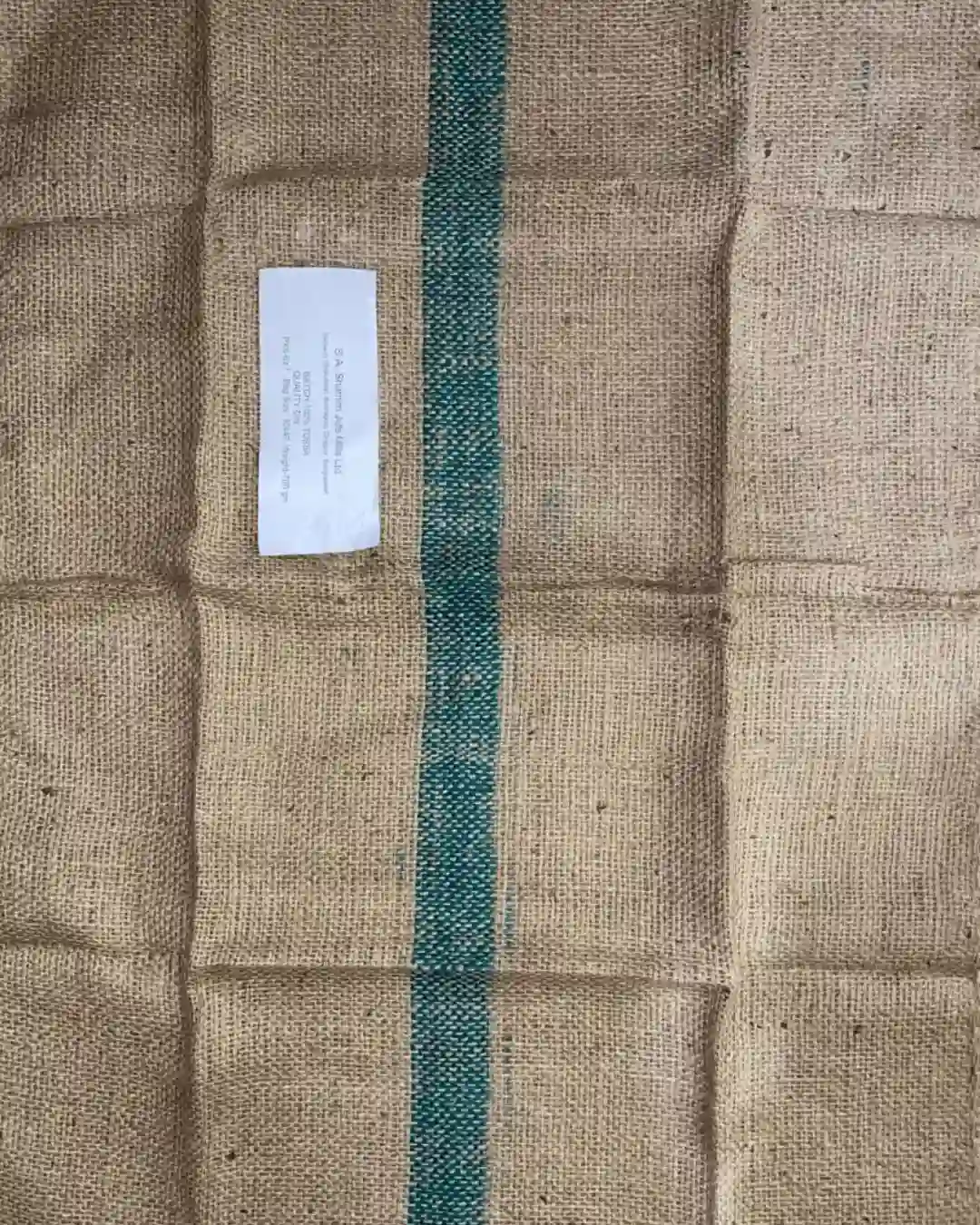
1. Decoding the Mill Floor QC Ticket: 100% Tossa Jute Sacking Bags Specifications
In international sacking procurement, physical inspection tickets tell the complete truth of mill execution. The production sample shown in Figure 1 represents an active export run engineered at our Dinajpur mill for institutional tossa jute sacking bags contracts in Saudi Arabia and the Middle East:
- Fiber Base (100% Tossa): Spun exclusively from select Northern Bangladesh *Corchorus olitorius* (Tossa jute), yielding greater cellulose orientation, higher tensile breaking strength, and superior golden-brown fiber luster compared to White jute (*Corchorus capsularis*).
- Quality Grade (D.W. – Double Warp): A 2/1 twill construction where two warp threads interlace over each heavy weft yarn, producing a dense structural wall that blocks light and resists abrasive snagging.
- Porter & Shots (6 × 7): Precisely calibrated thread count per standard inch (6 warp threads by 7 weft shots) ensuring balanced tensile strength across both machine and cross directions.
- Cut Size (30″ × 42″ / 76 × 107 cm): The globally recognized dimensional standard for 50 kg grain, wheat, sorghum, and rough paddy bagging.
- Tare Mass (700 Grams): Heavyweight commercial rating offering calibrated drop resistance when handled manually or via mechanical bag throwers.
2. Why Tossa Jute Sacking Bags Outperform White Jute & Synthetics in 50kg Stacks
When bulk grain is stacked 20 to 25 tiers high in non-climate-controlled port warehouses or national strategic grain reserves, synthetic woven polypropylene (PP) bags frequently fail. Polypropylene possesses zero friction coefficient; stacked slick plastic sacks easily slide, causing catastrophic stack collapses. More critically, polypropylene is non-porous. Thermal shifts between hot desert days and cold nights induce container sweat, trapping water inside and triggering rapid aflatoxin formation.
Natural tossa jute sacking bags solve both operational hazards through hygroscopic fiber action and high-friction contact:
Zero Stack Slippage
The natural hairy surface texture of raw spun Tossa yarns creates high frictional resistance, locking bags in place up to 25 tiers without pallet tilting.
Active Moisture Equilibrium
Absorbs up to 34% atmospheric vapor without feeling damp, releasing moisture gradually to prevent condensation and grain sweating.
Self-Healing Yarns
Unlike synthetic tapes that split irreparably when penetrated by stevedore cargo hooks, heavy twill jute fibers shift and self-close around punctures.
Eco-Compliant Disposal
Zero synthetic microplastics. Decomposes naturally into organic biomass without polluting agricultural soils or municipal disposal systems.
| Parameter | 50kg Tossa D.W. Sacking (Verified Lot) | Heavy B-Twill Commodity Sack |
|---|---|---|
| Primary Purpose | 50 kg Rice, Wheat, Grain & Pulses | 80 kg – 100 kg Raw Commodity / Cocoa |
| Standard Dimensions | 30″ × 42″ (76 × 107 cm) | 44″ × 26.5″ (112 × 67.5 cm) |
| Tare Weight Range | 700g (1.54 lbs) ± tolerance | 907g to 1,020g (2.0 to 2.25 lbs) |
| Weave Construction | Double Warp (D.W.) Twill • 6×7 PxS | Standard Twill • 6×8 PxS |
| Identification Marker | Single woven green security stripe | Triple blue stripes or custom print |
| Moisture Regain | 14% – 16% Max (Factory Monitored) | 16% – 18% Max |
| Seam Engineering | Heavy Herakles chain stitch + hemmed mouth | Overhead safety chain stitch |
4. Overhead Chain Stitching & Identification Stripe Mechanics
The structural weakness in cheap commercial packaging is invariably the side and bottom seam. Under rapid mechanical filling, drop impact forces concentrate directly on the seam line. SA Shamim Jute Mills Ltd integrates continuous overhead safety chain-stitching (Herakles overlock) into all tossa jute sacking bags using heavy multi-ply jute twine spun in-house.
“A secure sack seam requires precise tension harmony between the sacking fabric and the sewing yarn. Our automated sewing lines hem the bag mouth to prevent unraveling and execute high-gauge chain stitching that stretches under drop-impact rather than snapping.”
The woven green stripe visible on our physical sample serves as an indelible identification marker for port logistics and warehouse lot segregation. Unlike printed surface inks that can scratch off during stevedoring, woven identification stripes are integrated directly into the warp beam during the weaving stage, guaranteeing permanent batch visibility across global supply chains.
5. Integrated Manufacturing Scale & Statutory Licensing (Dinajpur Plant)
Procuring direct from the manufacturing source protects commodity traders from broker insolvency and shipment delays. Located in Batason, Muraripur, Bochaganj (Post: Setabganj), Dinajpur, SA Shamim Jute Mills Ltd commands one of Northern Bangladesh’s most modern integrated jute composite facilities.
Our industrial operations are governed by verified capacity benchmarks and statutory licensing:
- Monthly Capacity: 1,000+ Metric Tons monthly output, guaranteeing continuous container volume for multi-month supply contracts.
- Heavy Industrial Plant: 352+ heavy industrial machines spanning fiber softening, carding, drawing, spinning, high-speed weaving, and automated baling presses.
- Industrial Campus: 6+ acre integrated industrial campus housing raw fiber warehousing, production sheds, testing laboratories, and container stuffing staging yards.
- Skilled Workforce: 1,100+ skilled personnel maintaining tight physical quality assurance at every manufacturing stage.
- Statutory Factory License: Department of Inspection for Factories and Establishments (DIFE License: 27-21-1-056-00001, Valid to August 2027).
- Government Registered Exporter: Export Promotion Bureau (EPB Official Registered Exporter ID: 1968).
- Laboratory Certification: Indian Jute Industries’ Research Association (IJIRA Ref: TSR-195/2026-27; MOSH & MOAH compliant, < LOD migration under German BfR Method 2009).
- Institutional Export Execution: Contract-proven manufacturer for national agricultural boards and global merchants, including Le Conseil du Café-Cacao (Côte d’Ivoire 2026–2027 campaign), Colcocoa (Colombia), and Middle East grain buyers.
6. Container Stuffing & Port Logistics for Tossa Jute Sacking Bags
Finished export sacks are pressed into compact export bales using high-tonnage hydraulic presses, banded with heavy iron hoops or high-tensile poly-straps, and wrapped in protective hessian covers:
7. Frequently Asked Questions (B2B Trade Intelligence)
1. What is the standard MOQ for 50kg tossa jute sacking bags?
Our standard export Minimum Order Quantity (MOQ) is 1 × 20′ FCL container, which accommodates approximately 21 metric tons (around 30,000 units of 700g bags). Commercial trial consignments and physical air-freight swatch samples can be coordinated upon formal corporate inquiry.
2. Can you apply custom flexographic logo printing on tossa jute sacking bags?
Yes. Our factory operates in-house flexographic printing lines capable of applying up to 3-color custom branding, grain grading designations, crop years, and government contract stenciling directly onto the bag surface using colorfast, water-based inks.
3. How does SA Shamim Jute Mills facilitate pre-shipment inspections?
We routinely facilitate third-party pre-shipment inspections (PSI) with global agencies including SGS, Intertek, and Bureau Veritas. Inspectors can access our Dinajpur mill campus or conduct stuffing verification at Chattogram Port for bale counts, tare mass calibration, seam tensile tests, and moisture readings.
4. What payment terms and banking documents are supported?
We operate under standard Incoterms 2020 rules (FOB Chattogram, CFR, CIF). Accepted settlement methods include 100% Irrevocable Letter of Credit (L/C at Sight) issued by prime international banks, Advance T/T, or Cash Against Documents (CAD). Full shipping documentation—including Clean on Board Ocean Bills of Lading, Certificate of Origin, Packing Lists, and Phytosanitary Certificates—is executed promptly.
Lock In Direct Mill Production for Tossa Jute Sacking Bags
Partner directly with SA Shamim Jute Mills Ltd for guaranteed 1,000+ MT monthly capacity, physical QC verification, and dependable FCL container deliveries shipped via Chattogram Port.