Food-grade jute bags manufactured directly in Bangladesh provide the verified, hydrocarbon-free packaging required by international cocoa bean aggregators, specialty green coffee importers, and organic commodity merchants worldwide.
Key Sourcing Takeaways for Global Commodity Traders
- Purity Benchmark: Vegetable Oil Treated (VOT) hydrocarbon-free processing eliminates MOSH & MOAH migration risks in bulk cocoa beans and green coffee beans.
- Standard Cocoa Payload: Standard 44″ × 26.5″ (112 × 67.5 cm) tare weights (650g–1,020g) engineered for 65 kg Côte d’Ivoire and Ghanaian export standards.
- Direct Mill Capacity: 730+ Metric Tons monthly output across 352 heavy machines at our 5.35-acre integrated campus in Dinajpur, Bangladesh.
- Logistics & Terms: Approx. 21 MT per 20′ FCL (hydraulic-pressed export bales) shipped via Chattogram Port (BDCGP) under Incoterms 2020.
- 1. Why Hydrocarbon-Free (VOT) Processing is Mandatory
- 2. Industrial Comparison: Standard JBO vs. VOT Sacking
- 3. Technical Specifications for 65 kg Cocoa & Coffee Sacks
- 4. Laboratory Verification: IJIRA & German BfR Method 2009
- 5. Direct Mill Sourcing vs. Third-Party Intermediaries
- 6. Container Stuffing, Payload Metrics & Port Logistics
- 7. Frequently Asked Questions (B2B Sourcing Intelligence)
Unlike domestic non-food packaging, authentic food-grade jute bags must be manufactured without conventional petroleum-based batching oils. Understanding the technical specifications, batching methodologies, laboratory verification protocols, and multi-container sea logistics is essential for procurement directors seeking reliable, single-source mill supply from Bangladesh.
Why Hydrocarbon-Free (VOT) Processing is Mandatory in Food-Grade Jute Bags
For decades, traditional sacking bag production utilized Jute Batching Oil (JBO)—a middle-distillate petroleum hydrocarbon blend applied to soften stiff raw golden jute bast fibers during carding and drawing. While structurally robust for industrial goods and non-food sandbags, traditional JBO contains high levels of Mineral Oil Saturated Hydrocarbons (MOSH) and Mineral Oil Aromatic Hydrocarbons (MOAH).
When unrefined sacking comes into direct contact with high-fat, porous dry commodities such as green coffee beans, raw cocoa beans, shelled peanuts, and spices, these volatile hydrocarbon fractions migrate into the foodstuff. This migration ruins the delicate sensory cup profile of specialty coffee, contaminates cocoa butter, and violates the European Commission’s food-contact material directives.
| Feature | Traditional JBO Sacking | VOT Food-Grade Jute Bags |
|---|---|---|
| Softening Batching Agent | Petroleum Distillate / Mineral Oil (JBO) | Refined Vegetable Oil (VOT) |
| Hydrocarbon Migration | High MOSH/MOAH contamination risk | Batch-tested below detection limits (< LOD) |
| Sensory & Odour Impact | Noticeable petroleum kerosene odor | Completely odorless & neutral fiber profile |
| Approved Applications | Grain, seeds, potatoes, sandbags, textiles | Raw cocoa beans, specialty coffee, organic grains |
| Testing Standard | Industrial standard (non-edible) | Tested under German BfR Method 2009 (SPE-GC-FID) |
Technical Specifications for 65 kg Bulk Cocoa & Coffee Sacks
International trade bodies—including the International Cocoa Organization (ICCO) and major green coffee federations—enforce standardized physical tolerances for export sacking. To withstand rough multimodal transshipment, high-stack warehousing, and hydraulic container stuffing, SA Shamim Jute Mills Ltd engineers premium food-grade jute bags according to rigorous parameters:
44″ × 26.5″ (112 × 67.5 cm)
Standard 65 kg cocoa bean capacity (West Africa). Optional 44″ × 28.5″ (112 × 72 cm) and bespoke custom cut dimensions available per sales order.
650g to 1,020g per Bag
Calibrated bag weight according to buyer specification (1.43 lbs to 2.25 lbs). Fabricated with tight porter and shot twill weaves.
Heavy-Duty Safety Chain-Stitch
Overhead chain-stitch overlocked selvedges and hemmed mouth prevent edge fraying and bag bursting during high-stack warehousing.
Food-Grade Flexographic Ink
Food-grade colored side stripes (single, double, or triple blue/green) and multi-color buyer branding logo printing.
Laboratory Verification: The Role of IJIRA and German BfR Method 2009
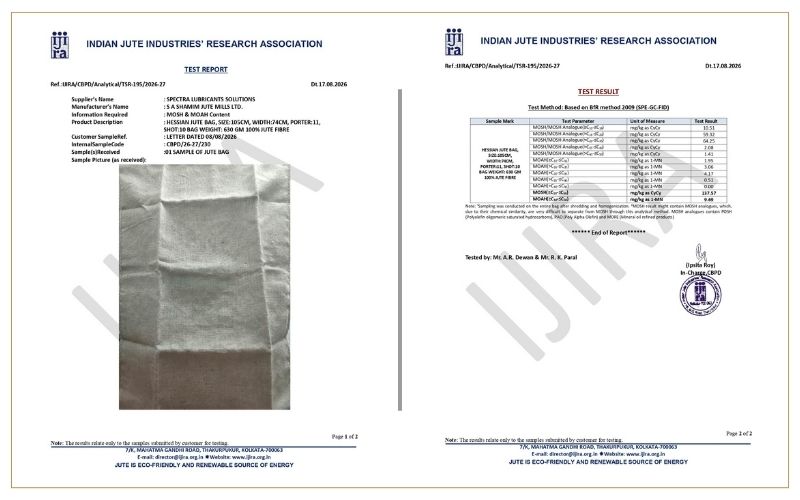
Procuring verified food-grade jute bags requires independent laboratory evidence. In the global jute sector, testing conducted by the Indian Jute Industries’ Research Association (IJIRA) serves as the internationally recognized benchmark for hydrocarbon migration analysis.
Laboratory analysis utilizing SPE-GC-FID (Solid Phase Extraction – Gas Chromatography – Flame Ionization Detection) based on the German Federal Institute for Risk Assessment (BfR Method 2009) ensures that:
“A tested sample from SA Shamim Jute Mills Ltd holds an independent IJIRA MOSH & MOAH test report (Ref: TSR-195/2026-27), confirming that both Mineral Oil Saturated Hydrocarbons and Mineral Oil Aromatic Hydrocarbons remain strictly below the limit of detection (< LOD). Complete laboratory test dossiers are made available upon formal commercial inquiry.”
Direct Mill Sourcing vs. Third-Party Intermediaries
Global procurement heads frequently encounter third-party export brokers who lack production control. Procuring directly from an integrated composite manufacturer provides commercial certainty, direct mill pricing, and strict batch traceability.
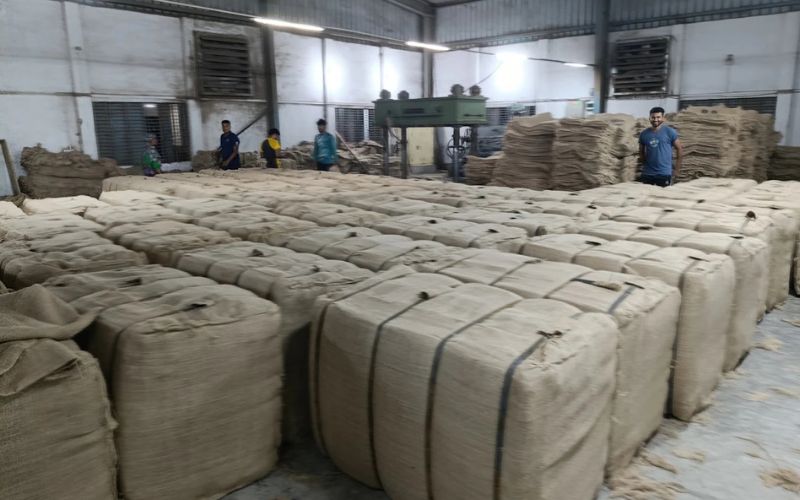
Operating from our 5.35-acre (534.5 decimals) industrial campus in Batason, Muraripur, Bochaganj, Dinajpur, SA Shamim Jute Mills Ltd integrates fiber batching, spinning, weaving, cutting, flexographic printing, and hydraulic pressing under one roof. With an active production fleet of 352 heavy machines and 810+ skilled workers, our installed capacity exceeds 730+ metric tons per month.
Our facility operates under official statutory industrial governance:
- Statutory Factory Licensing: Licensed under the Department of Inspection for Factories and Establishments (DIFE Establishment ID: 93407 | Lic: 27-21-1-056-00001).
- Export Accreditation: Registered direct exporter with the Export Promotion Bureau (EPB Exporter ID: 1968 | Reg: NT01474).
- Industry Association: Active member of the Bangladesh Jute Mills Association (BJMA).
Container Stuffing, Payload Metrics & Port Logistics
For ocean freight optimization, export-grade food-grade jute bags are compressed into iron-bound hydraulic bales to maximize payload density and protect fibers during maritime transit.
Frequently Asked Questions (B2B Sourcing Intelligence)
1. What makes a jute bag officially suitable as “Food-Grade”?
An authentic food-grade jute bag is batched exclusively with refined vegetable oils (VOT) instead of petroleum-based JBO. It must undergo independent analytical chromatography (SPE-GC-FID) testing verifying that MOSH and MOAH hydrocarbon migration levels remain below laboratory limits of detection (< LOD), compliant with German BfR Method 2009.
2. What is the standard packaging and minimum order quantity (MOQ)?
The standard export Minimum Order Quantity (MOQ) is 1 × 20′ FCL container, which accommodates approximately 21 metric tons of hydraulic-pressed food-grade jute bags. Commercial trial orders and swatch sample air freight consignments are negotiable upon inquiry.
3. Can buyers arrange independent third-party pre-shipment inspections?
Yes. As a direct composite manufacturer, SA Shamim Jute Mills Ltd routinely coordinates with international inspection agencies—including SGS, Intertek, and Bureau Veritas—for pre-shipment physical count, moisture verification, seam strength testing, and seal verification prior to factory gate dispatch.
4. How do international commodity traders request a formal proforma invoice?
International commodity merchants, green coffee roasters, and cocoa aggregators can submit customized dimensional specifications, bag weights, and required destination ports directly to our Commercial Export Desk. Formal Proforma Invoices with firm FOB Chattogram or CIF seaport quotations are provided within 24 business hours.
Secure Your Food-Grade Jute Sacks for the Upcoming Harvest
Partner directly with SA Shamim Jute Mills Ltd for guaranteed monthly production capacity, batch-tested purity, and dependable FCL ocean dispatches worldwide.