Food grade jute bags engineered by SA Shamim Jute Mills Ltd provide international agricultural commodity exporters with certified, vegetable-oil-treated packaging that eliminates mineral hydrocarbon contamination. Established in 2019 under the direct leadership of Founder and Managing Director Shamim Akhter Hossain, our integrated 6+ acre manufacturing complex in Dinajpur, Bangladesh, transforms premium tossa fibers into high-density export packaging compliant with strict European, Middle Eastern, and North American food-contact regulations.
When sourcing food grade jute bags for bulk agricultural commodities such as raw cocoa beans, green specialty coffee, shelled groundnuts, and organic grains, lipid-rich crops readily absorb volatile mineral hydrocarbons. When packaged in standard commercial gunny bags manufactured using conventional mineral batching oils (JBO), these sensitive crops face cross-contamination, aroma deterioration, and port-of-entry rejection under strict European Food Safety Authority (EFSA) thresholds. Our Dinajpur manufacturing plant resolves this supply chain vulnerability through dedicated vegetable oil batching (VOT) lines calibrated to stringent international purity thresholds.
Mill Infrastructure & Export Capacity
Engineering Specifications: Food Grade Jute Bags vs. Conventional Sacking
The manufacturing benchmark of high-performance food grade jute bags lies in replacing petroleum-derived mineral batching oils with non-toxic vegetable oil emulsions during fiber softening. Conventional jute processing relies on mineral oils containing heavy concentrations of mineral oil saturated hydrocarbons (MOSH) and mineral oil aromatic hydrocarbons (MOAH). These volatile fractions volatilize under container condensation conditions, migrating directly into cocoa nibs and coffee beans.
Our automated VOT spinning and weaving lines guarantee that all food grade jute bags maintain the natural capillary respiration of raw bast fibers while guaranteeing strict zero-odor neutrality. This clean mechanical preparation preserves delicate coffee cupping profiles and single-origin cocoa purity during lengthy ocean transit cycles.
| Technical Parameter | Standard Sacking (Commercial) | Food Grade Jute Bags (SA Shamim VOT) | Testing Methodology |
|---|---|---|---|
| Batching Medium | Petroleum-derived JBO | 100% Refined Vegetable Oil (VOT) | Gas Chromatography |
| Aromatic Hydrocarbons | Variable (> 1,000 mg/kg) | MOSH/MOAH Undetectable / Compliant | German BfR 2009 (SPE-GC-FID) |
| Moisture Regain Limit | 17% to 22% (Variable) | 14.0% to 16.0% (Contract Maximum) | Oven Dry Method / ISO 287 |
| Odor Profile | Distinct kerosene/diesel trace | Completely Odorless & Neutral | Organoleptic Panel Sniff Test |
| Seam Construction | Single chain-stitch (overhead) | Safety Lock + Herakles Overlock | ASTM D4884 Seam Tensile |
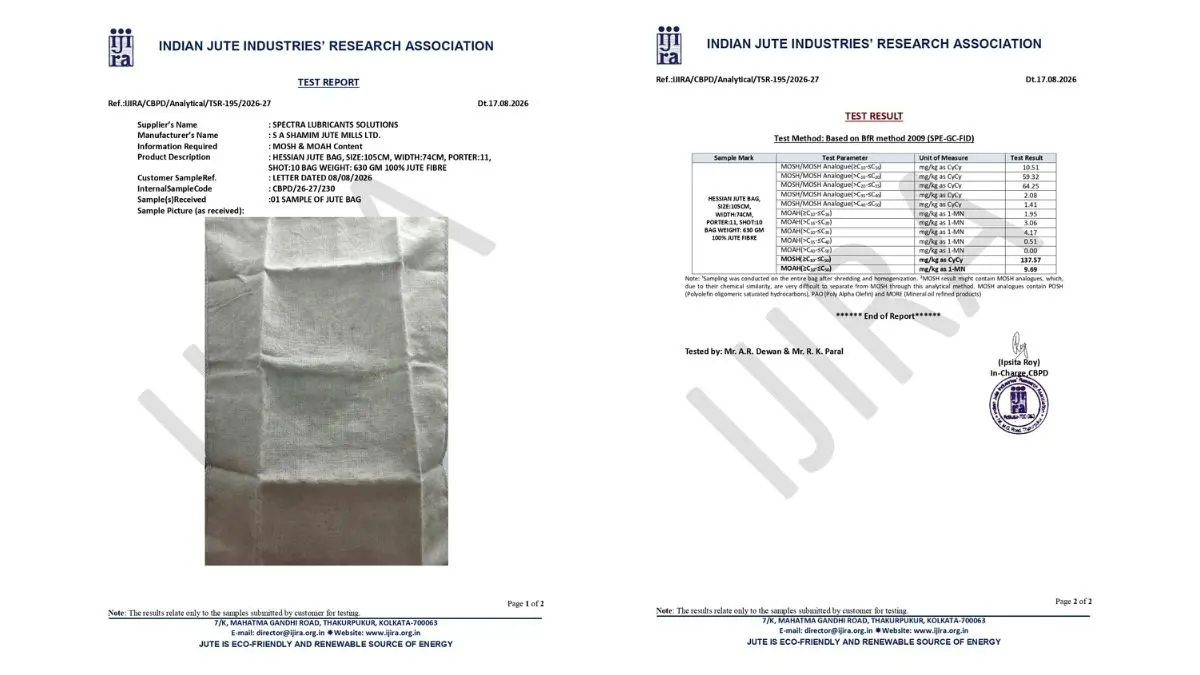
MOSH/MOAH Laboratory Limits for Food Grade Jute Bags (German BfR 2009)
To certify our food grade jute bags under European Union food contact thresholds, SA Shamim Jute Mills Ltd maintains rigorous analytical screening certified by the Indian Jute Industries’ Research Association (IJIRA) under laboratory test certificate Ref: TSR-195/2026-27.
Analytical testing executed under the German Federal Institute for Risk Assessment method—BfR Method 2009 (SPE-GC-FID)—validates that our food grade jute bags meet strict hydrocarbon limits across all carbon fractions (C10 through C50). Each production heat batch undergoes systematic specimen extraction to guarantee zero transfer of mutagenic aromatic compounds into commercial food chains.
Container Logistics for Food Grade Jute Bags in FCL Shipments
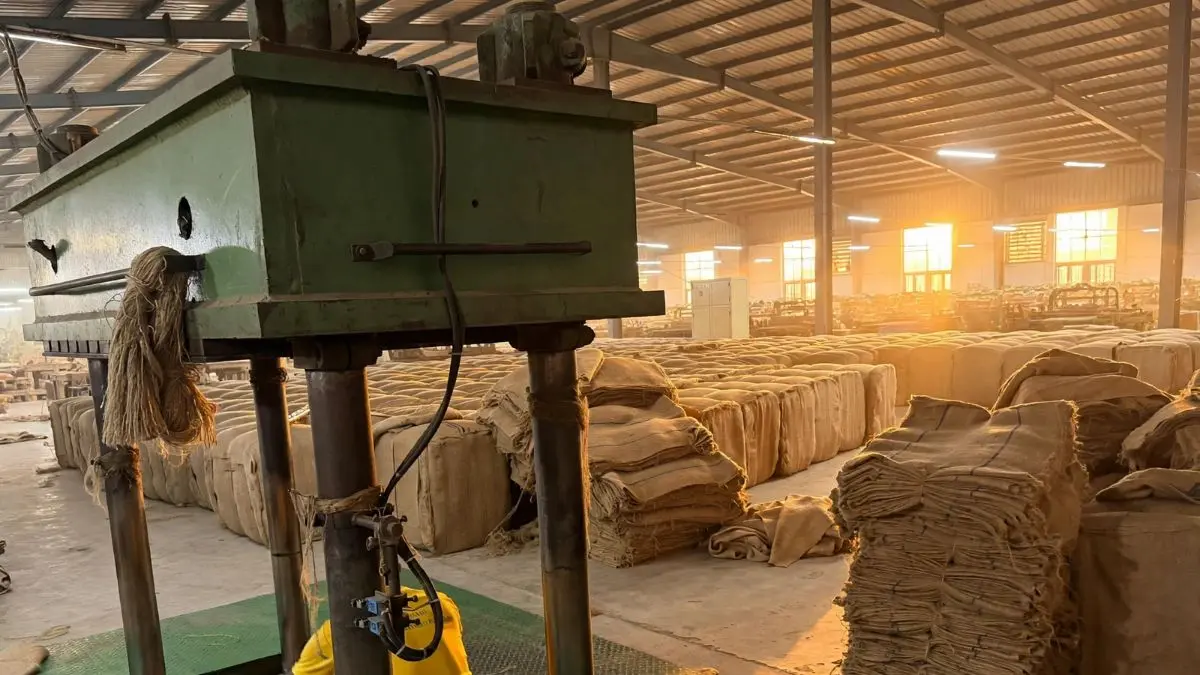
Optimizing maritime freight costs for food grade jute bags is critical for global commodity desks managing cocoa beans (standard 65 kg gross), green coffee beans (60 kg net), and raw sugar. Precision weaving ensures dimensional consistency while heavy hydraulic bailing presses compress our export units into tight, steel-banded bales wrapped in clean protective sacking.
This automated packaging architecture prevents container friction and condensation dampness during transshipment through Chattogram Sea Port (UN/LOCODE: BDCGP), safeguarding product integrity across ocean voyages to Europe, the Middle East, and the Americas.
| Standard Bag Spec | Dimensions (L × W) | Tare Unit Weight | Weave Structure | 20′ Dry FCL Load | 40′ HC FCL Load |
|---|---|---|---|---|---|
| Standard B. Twill | 44″ × 26.5″ 112 cm × 67.3 cm | 2.25 lbs 1,020 grams | Porter 6 / Shot 8 (2/1 Twill) | ~21.0 MT (65 Bales) | ~26.5 MT (85 Bales) |
| Heavy Cees (Cocoa) | 40″ × 28.0″ 101.6 cm × 71.1 cm | 2.00 lbs 907 grams | Porter 8 / Shot 8 (Twill Weave) | ~20.5 MT (70 Bales) | ~26.0 MT (90 Bales) |
| Standard Light Cees | 40″ × 28.0″ 101.6 cm × 71.1 cm | 1.75 lbs 793 grams | Porter 8 / Shot 7 (Twill Weave) | ~21.0 MT (75 Bales) | ~27.0 MT (95 Bales) |
| Hessian Coffee Bag | 40″ × 28.0″ 101.6 cm × 71.1 cm | 1.39 lbs 630 grams | Porter 11 / Shot 12 (Plain Weave) | ~18.5 MT (80 Bales) | ~24.5 MT (100 Bales) |
Pre-Shipment Quality Protocol for Food Grade Jute Bags
Every commercial consignment of food grade jute bags produced at our Dinajpur campus undergoes strict quality screening governed by DIFE Factory License No: 27-21-1-056-00001 and certified under our official statutory compliance standards. Independent international surveyor inspections—including SGS, Intertek, and Bureau Veritas—are routinely conducted on buyer nomination prior to container gate-in at export terminals.
Fiber Selection & VOT Emulsification
Only matured Grade-3/Grade-4 tossa raw jute fibers are selected. Non-mineral food-grade vegetable oils are applied under metered pump automation to guarantee absolute oil penetration without hydrocarbon residue.
Continuous Weave Calibration
Loom reeds and shuttle mechanics undergo real-time tension monitoring to ensure uniform porters and shots per inch, preventing grain leakage under high static stacking loads.
Moisture Regain Conditioning
Sacking cloth passes through controlled thermo-calendering lines to fix commercial moisture regain between 14.0% and 16.0%, eliminating tropical fungal proliferation during ocean transit.
Tensile & Hydrocarbon Screening
Finished food grade jute bags undergo burst testing and gas chromatography screening against BfR 2009 parameters prior to high-density hydraulic baling and export strapping.
Explore our complete institutional product lines by visiting our jute products catalog or reviewing our verified commercial registry with the Bangladesh Export Promotion Bureau (EPB Exporter ID: 1968).
Frequently Asked Technical Questions (B2B Procurement)
What makes food grade jute bags compliant with European Food Safety Authority limits?
What is the standard container stuffing capacity for 20′ and 40′ FCL shipments?
What incoterms, payment mechanisms, and logistics routes are supported?
Can prospective commercial buyers request laboratory physical samples?
Initiate Direct Factory Procurement (FCL Export Orders)
Contact our commercial export department in Dinajpur for custom dimensions, striping configurations, and formal FOB Chattogram or CIF spot freight quotes backed by our 1,000+ MT monthly licensed output.