Producing export-grade sustainable jute bags requires tight process control from Corchorus bast fiber retting in northern Bangladesh to hydraulic bale pressing. Operating since 2019 on a 6+ acre Dinajpur campus, SA Shamim Jute Mills Ltd runs 352+ heavy machines and 1,100+ skilled personnel to convert raw fiber into 1,000+ MT of VOT food-grade sacks, heavy sacking, yarn, and hessian cloth every month.
From Corchorus Fields to Industrial Sustainable Jute Bags
Every batch of sustainable jute bags begins in the rain-fed alluvial plains of northern Bangladesh, where Corchorus capsularis (white jute) and Corchorus olitorius (tossa jute) grow to maturity within 120 days. Because SA Shamim Jute Mills Ltd operates inside Dinajpur, our fiber buyers inspect harvested reeds directly before mill batching.
Raw jute demands minimal synthetic fertilizers and relies on seasonal monsoon rainfall, enriching crop-rotation soil while supplying a naturally biodegradable and breathable bast fiber. Once stalks are cut, farmers bundle them for slow microbial water retting—loosening the outer bast layer from the woody core—before stripping, washing, and sun-drying long golden ribbons ready for industrial processing into sustainable jute bags.
Founded in 2019 by Managing Director Shamim Akhter Hossain, our mill at Batason, Muraripur, Post: Setabganj-5216, Bochaganj, Dinajpur sits inside this prime agricultural corridor. Positioning a 534.5-decimal (6+ acre) factory beside the harvest zone cuts intermediate transport handling and gives our batching team direct control over moisture levels, reed strength, and root-end trimming. Explore our Dinajpur campus on the SA Shamim Jute Mills Ltd homepage.
Clean Bast Fiber Grading
Raw reeds arriving in Dinajpur are sorted by color, tensile strength, and cleanliness so sustainable jute bags maintain uniform weave tension across 60kg–69kg agricultural loads.
Captive-Power Continuity
Uninterrupted captive electricity keeps all 352+ preparatory, spinning, and weaving machines running continuously without seasonal utility grid disruptions.
The 6-Stage Manufacturing Process Behind Sustainable Jute Bags
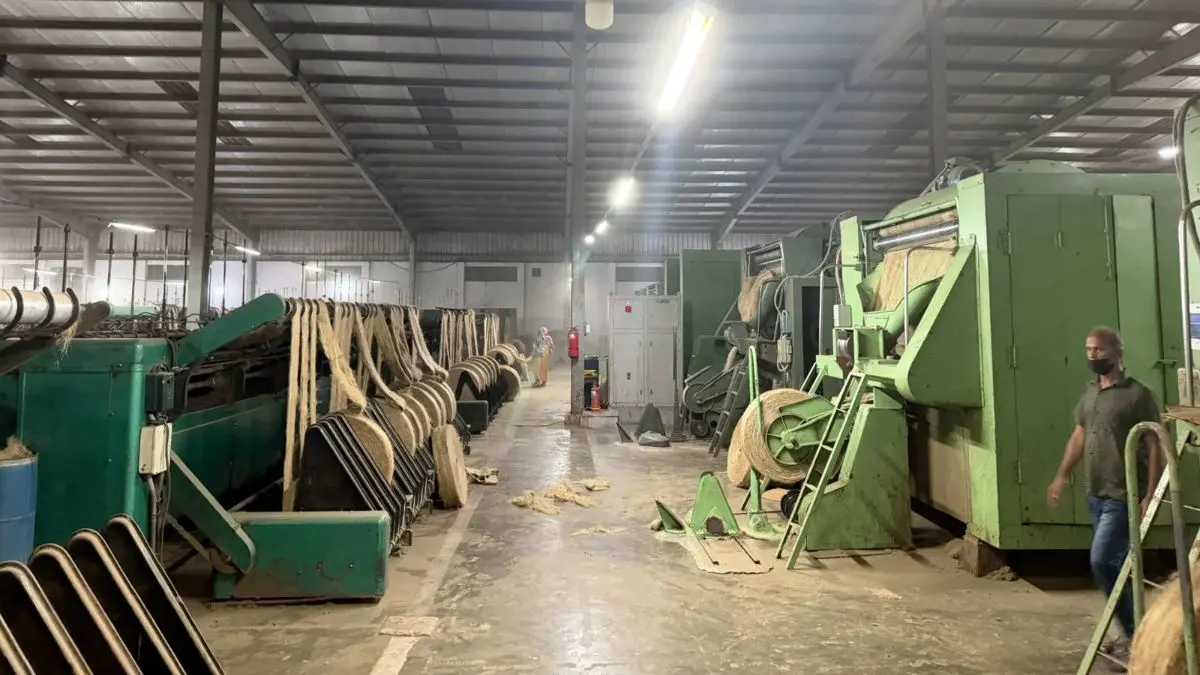
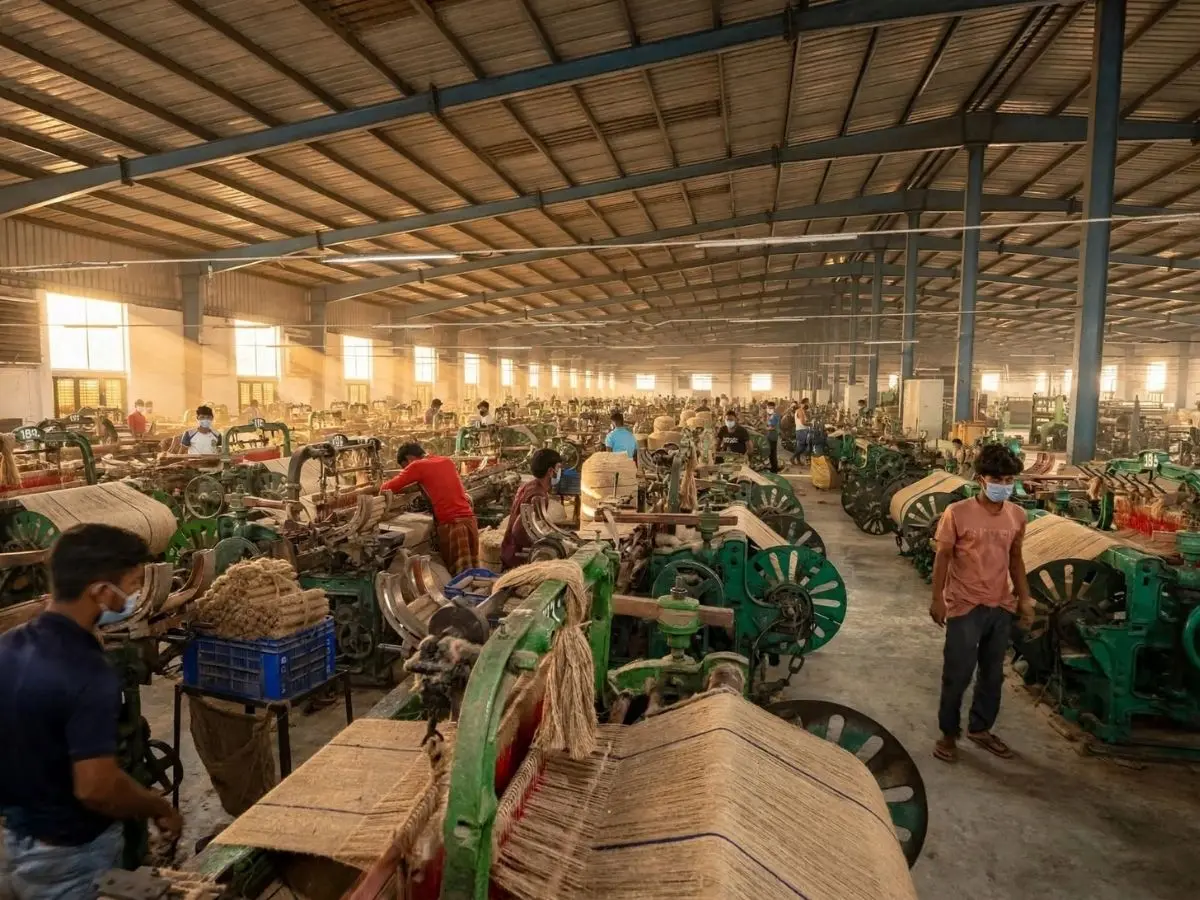
Converting raw bast reeds into export-ready sustainable jute bags requires six calibrated mechanical stages inside our Dinajpur sheds. SA Shamim Jute Mills Ltd executes every step under one roof—from softening and carding to high-speed weaving and steel-strapped hydraulic baling.
| Production Stage | Mill Machinery & Engineering Process | In-Line Quality Check |
|---|---|---|
| 1. Fiber Selection & Softening | Root cutting and feeding dry bast stricks through fluted-roller softeners sprayed with controlled oil-water emulsion. | Moisture conditioning & strict Vegetable Oil Treated (VOT) separation for food-grade lots. |
| 2. Breaker & Finisher Carding | Pinned cylinders comb softened reeds into continuous, aligned fiber fleeces and uniform sliver ribbons. | Sliver linear density (ktex) checks to eliminate thick/thin yarn defects. |
| 3. Drawing & Doubling | Three passes through drawing frames blend multiple slivers to parallelize bast fibers and equalize weight. | Evenness monitoring across warp and weft feed cans. |
| 4. Flyer Spinning | High-speed flyer spinning frames twist drafted slivers into 8 lbs to 28 lbs yarns (1 to 4 ply) in CRM, CRT, CRX, and CB grades. | Breaking load tensile verification and yarn count consistency checks. |
| 5. Weaving & Calendering | Rapier and cop-change looms weave heavy twill sacking and 22"–72" plain-weave hessian, then heated calenders smooth the cloth. | Porter-and-shot reed density, width, and GSM weight audits. |
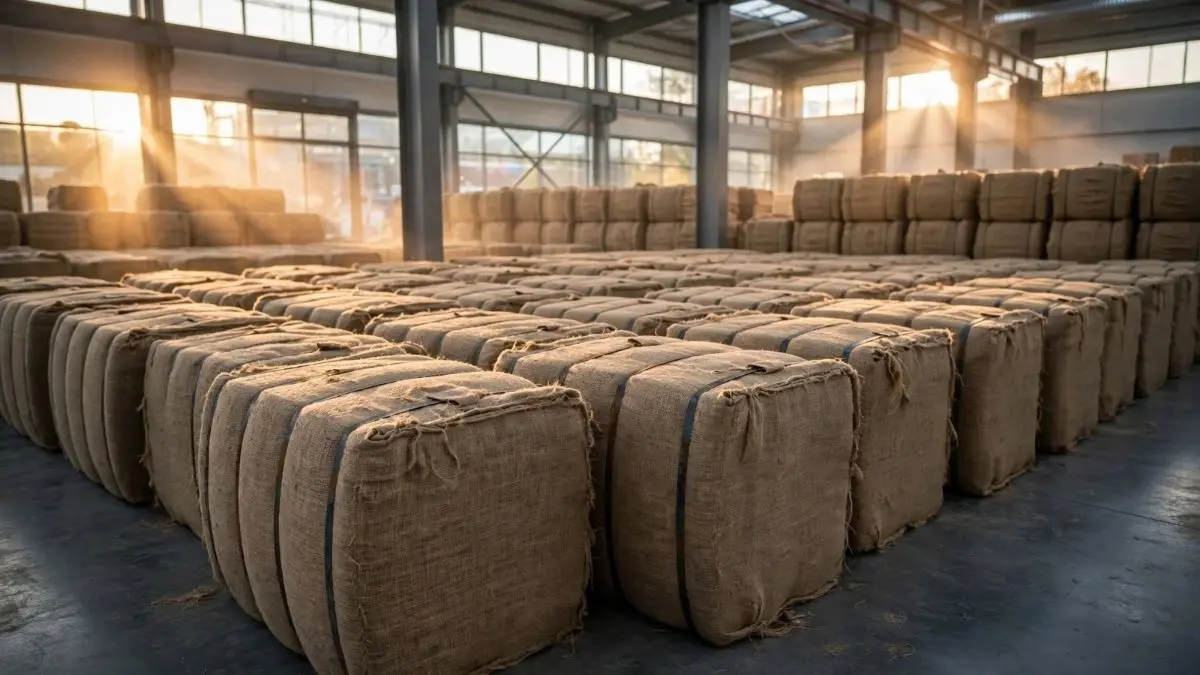
| 6. Stitching & Hydraulic Baling | Cutting, hemming, safety stitching, buyer stenciling, and compressing 200–500 bags per bale under hydraulic balers. | Seam tensile pull tests, net tare weight, and steel-strap tensioning. |
Stage 1 governs food-contact compliance. Rather than applying mineral batching oils across food-grade production, our softening lines isolate Vegetable Oil Treated (VOT) emulsions for cocoa, coffee, and grain sacks. Maintaining clean oil chemistry at the softener ensures downstream sustainable jute bags stay aligned with European mineral-hydrocarbon limits before spinning even starts.
Industrial Specifications & B2B Customization for Sustainable Jute Bags
Importers procuring sustainable jute bags from Dinajpur can order standardized commodity sizes or engineer custom dimensions, GSM weights, and stenciling. Our mill exports four primary industrial product lines under HS 6305.10, HS 5307, and HS 5310.
| Export Line | HS Code | Verified Technical Specifications | B2B Applications |
|---|---|---|---|
| Food-Grade Low-MOH Sacks | HS 6305.10 | VOT-processed 65kg/69kg Cocoa sacks, 60kg Coffee sacks, and heavy Grain sacks with safety stitching. | Cocoa & coffee shipping from Côte d’Ivoire, Ghana, and Latin America. |
| Heavy Jute Sacking Bags | HS 6305.10 | B-Twill (1020g, triple blue stripes, 44"x26.5"), Binola (907g), A-Twill, Kat Binola, L-Twill, Heavy & Light Cees, Double Warp (D.W.) Flour Sacks. | Bulk rice, sugar, pulses, flour, and grain commodity warehousing. |
| Industrial Jute Yarn & Twine | HS 5307 | 8 lbs to 28 lbs (1 to 4 ply) in CRM, CRT, CRX, and CB grades wound on export-grade spools. | High-speed carpet backing in Turkey & EU; industrial tying & weaving. |
| Hessian Cloth & Burlap | HS 5310 | 22" to 72" width; 5 oz to 14 oz (150 to 450 GSM) plain weave in continuous rolls and hydraulic bales. | Upstream fabric for bag converters, concrete curing, and nursery wrap. |
Commodity procurement boards rely on our jute products manufacturing line for custom porter-and-shot weave densities, colored identification stripes, hemming profiles, and multi-color buyer stenciling. For coffee and cocoa cooperatives, our food-grade jute bags export program tailors 60kg to 69kg bag capacity with reinforced bottom seams built for stacked ocean containers.
In addition to finished sacks, downstream bag makers and agricultural converters purchase upstream fabric from our hessian cloth manufacturer in Bangladesh division. By supplying 150 to 450 GSM burlap rolls alongside 8 lbs to 28 lbs industrial yarns, we enable regional converters to stitch localized sustainable jute bags or run high-speed weaving looms without maintaining their own spinning sheds.
VOT Oil Treatment, Breathability & Pre-Shipment Audits
Finished sustainable jute bags protect moisture-sensitive agricultural cargo because natural bast fibers breathe inside humid ocean containers. Pairing breathable weaving with Vegetable Oil Treated (VOT) softening prevents mineral oil transfer into packed cocoa, coffee, and grains.
Unlike synthetic woven polypropylene sacks that trap condensation and raise mold risk during 30-day ocean voyages, sustainable jute bags allow controlled vapor exchange while holding high tensile resistance under steel dock hooks. Our VOT-processed food-grade lines are aligned with German BfR Method 2009 (SPE-GC-FID) MOSH/MOAH screening—with our latest IJIRA analytical test report available on request. Before container loading, buyers can also arrange independent SGS, Intertek, or Federal Inspection Services (FIS) inspections at our mill.
Statutory Licenses, Export Registries & Global Port Terms
Every container of sustainable jute bags leaves SA Shamim Jute Mills Ltd under verified Bangladesh factory and export licensing. We ship via Chattogram Sea Port (UN/LOCODE: BDCGP) and four land customs ports across all 11 Incoterms 2020.
DIFE Factory & Labour Compliance
DIFE Registered Factory (License No: 27-21-1-056-00001, Ministry of Labour & Employment), governing workplace safety for our 1,100+ Dinajpur staff.
EPB Exporter ID #1968
Confirm our active government export registration directly on the Export Promotion Bureau (EPB) Directory.
Bangladesh Export Registry
Inspect our verified corporate manufacturing listing via the Bangladesh Export Trade Directory.
Containers, Ports & Payments
20′ Dry FCL (~21 MT) & 40′ FCL/HC (~26 MT) via Chattogram (BDCGP), Benapole, Sona Masjid, Bhomra & Banglabandha under 100% L/C at Sight, T/T, CAD/DP, or D/A.
Download Corporate Profile & Technical Dossier (PDF)
Review machine schedules, standard bag dimensions, bale counts, and export credentials for our sustainable jute bags and upstream yarn/hessian lines.
Field-to-Fabric FAQs on Ordering Sustainable Jute Bags
Global procurement managers regularly confirm minimum container volumes, VOT oil screening, and sample courier terms before booking vessel space. These answers summarize direct mill specifications at SA Shamim Jute Mills Ltd.
What is the minimum order quantity for export sustainable jute bags?
Standard orders begin at one 20′ Dry FCL container (approximately 21 MT, baled at 200–500 bags per hydraulic bale). Mixed container loads across B-Twill, Binola, VOT food-grade sacks, or hessian rolls can be arranged on request.
Where is SA Shamim Jute Mills Ltd located and what is its monthly capacity?
Our 6+ acre (534.5-decimal) captive-power factory operates at Batason, Muraripur, Post: Setabganj-5216, Bochaganj, Dinajpur, Bangladesh, exporting 1,000+ MT monthly since 2019.
How are food-grade cocoa and coffee bags kept low-MOH?
Our food-grade sustainable jute bags are processed on dedicated Vegetable Oil Treated (VOT) softening lines aligned with German BfR Method 2009 (SPE-GC-FID) MOSH/MOAH screening, with our latest IJIRA analytical test report available on request.
Which markets and Incoterms 2020 do you support?
We export under all 11 Incoterms 2020 (EXW through DDP) to Turkey, Germany, Netherlands, UK, USA, Côte d’Ivoire, Ghana, Sudan, UAE, Oman, Saudi Arabia, and Latin America, with buyer-nominated SGS, Intertek, or FIS inspections.
Can importers test physical fabric or sack samples before ordering?
Yes. Free physical sack, hessian cloth, and yarn samples are available on request directly from Dinajpur; buyers cover DHL or FedEx courier freight.
Source Mill-Direct Sustainable Jute Bags from Dinajpur
Contact our export desk for FOB Chattogram or CIF destination container quotes, IJIRA test documentation, or custom weaving specifications backed by 352+ machines and 1,000+ MT monthly capacity.